Definitions & FAQs Application Notes Demo Videos
Mesh & Micrometer Pre & After Service Literatures

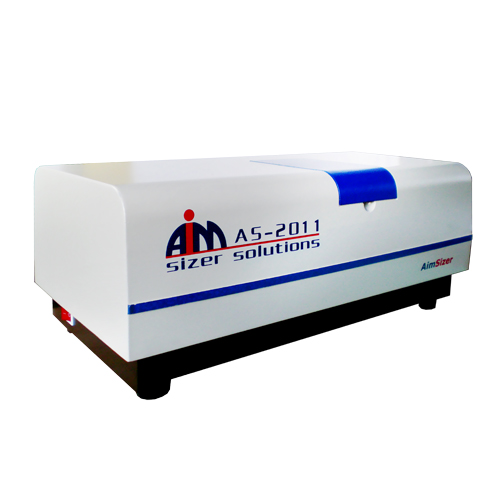
Laser Particle Size Analyzer


1. absorption
  reduction of intensity of a light beam traversing a medium through energy conversion in the medium.
   
2. coefficient of variation
  relative measure for precision:standard deviation divided by mean value of population and multiplied by 100(for normal distributions of data the median is equal to the mean)
   
3. complex refractive index
  refractive index of a particle,consisting of a real and an imaginary(absorption) part.
   
4. relative refractive index
  complex refractive index of a particle,relative to that of the medium
   
5. deconvolution
  mathematical procedure whereby the size distribution of a particle ensemble is inferred from measurements of their scattering pattern.
   
6. diffraction
  spreading of light around the contour of a particle beyond the limits of its geometrical shadow with a small deviation from rectilinear propagation.
   
7. extinction
  attenuation of a light beam traversing a medium through absorption and scattering.
   
8. model matrix
  matrix containing light scattering vectors for unit volumes of different size classes,scaled to the detector's geometry,as derived from model computation.
   
9. multiple scattering
  subsequent scattering of light at more than one particle,causing a scattering pattern that is no longer the sum of the patterns from all individual particles(in contrast to single scattering).
   
10. obscuration(optical concentration)
  percentage or fraction of incident light that is attenuated due to extinction(scattering and/or absorption) by the particles.
   
11. optical model
  theoretical model used for computing the model matrix fro optically homogeneous spheres with,if necessary,a specified complex refractive index,e.g.Fraunhofer diffraction,anomalous diffraction,Mie scattering.
   
12. reflection
  return of radiation by a surface,without change in wavelength.
   
13. refraction
  change of the direction of propagation of light determined by change in the velocity of propagation in passing from one medium to another;in accordance with Snell's law.
   
14. scattering
  general term describing the change in propagation of light at the interface of two media.
   
15. scattering pattern
  angular or spacial pattern of light intensities originating from scattering,or the related energy values taking into account the sensitivity and the geometry of the detector elements.
   
16. single scattering
  scattering whereby the contribution of a single member of a particle population to the scattering pattern of the entire population is independent of the other members of the population.
   
17. width of normal size distribution
  standard deviation(absolute value) or coefficient of variation(relative percentage) of the size distribution.
   
18. What is a particle
  A particle is a minute object with a certain size and shape. Macroscopically it is very small, but microscopically, a particle contains numberous molecules and atoms.
   
19. What is particle size
  Although this simply implies particle size is the size of an individual particle, determing absolute particle size can be difficult.
   
20. What is particle size distribution
  The number of particles that fall into each of the various size ranges given as a percentage of the total number of all sizes in the sample of interest.
   
21. How to describe particle size distribution
  -Table: percentage of particles from the total within a size range;it includes differential distribution and cumulative distribution

-Figure: particle distribution by histogram and curves, etc

-Function: particle distribution functionally including R-R distribution and normal distribution
   
22. What is particle diameter
  It is the diameter of a particle normally expressed either in microns or nanometers.
   
23. What is equivalent particle diameter
 
The equivalent particle diameter is divided into the following meanings:

-Equivalent projected area diameter
Diameter of a circle having the same area as the particle's projection

-Equivalent surface area diameter
Diameter of a a sphere having the same surface area as the particle

-Equivalent volume diameter
Diameter of a sphere having the same volume as the particle

-Equivalent sieve (near-mesh) diameter
Diameter of particles that just pass through the apertures of a sieving medium (near-mesh diameter, sometimes calibrated or normimal aperture size of sieve)

-Stokes diameter
Diameter of a sphere having the same settling rate as the particle under conditions of Stokes's law

   
24. Why introduce equivalent particle diameter
  In practice, particles are not uniformly shaped therefore they are difficult to define in a signle number. By correlating the particle to a sphere, one number can describe the size of a geometrically complicated particle.
   
25. What is D50
  Also known as the median diameter or the medium value of the particle size distribution, it is the value of the particle diameter at 50% in the cuculative distribution. It is one of an important parameter for representing particle size. For example, if D50=5um, then 50% of the particles in the sample are larger than 5um, and 50% smaller than 5um.
   
26. What is average diameter
  It is the weighted averaghe of particle size.
   
27. What is D97,What is the purpose of it
  It is the particle diameter value where 97% of the sample is smaller than that value. It is useful for determining the upper limit to the particle size distribution
   
28. What are frequently used methods to test particle size
  There are microscope imaging methods, sieve analysis, gravity sedimentation, centrifugal sedimentation, Coulter(resistance) analysis, laser diffraction / scattering methods, electron microscope, ultrasonic, gas sorption, etc.
   
29. Advantages and disadvantages of the above methods
  -Microscope Imaging
A: simple, direct test procedure, shape analysis available
D: long test cycle, relatively poor representation, testing of ultra fine particles not possible

-Sieve Analysis
A:simple, direct test procedure, low cost
D:samples smaller than 40um can not be tested; test results are subject to deformation of sieve meshes

-Sedimentation
A:low price, continuous operation, high degree of accuracy and repeatability, relatively broad test range
D:long test cycle

-Coulter
A:easy operation short testing cycle, relatively high accuracy
D:narrower size range, easily blocked apertures, electric conductivity of medium necessary

-Laser diffraction
A:easy operation, broad test range, high degree of accuracy and repeatability on-line test and dry test available.
D:test results are subject to distribution pattern, high cost of instrument
-Electron Microscope
A:capable of measuring particles of nanometer size, high resolution
D:possible alternation of particles during sample preparation, small representation of overall sample, and high cost

-Ultrasonic
A:direct test on highly concentrated liquid
D:low resolution

-Gass absorption
A:low cost of instrument, sample dispersion not an issue, testing on magnetic powders capable
D:only average particle size available, particle size distribution unobtainable
   
30. What are differential distribution and cumulative distribution
  Differential distribution is the percentage of particles from the total that are withiin a specified size range; for example, 30% within 1-10um range, 50% within 10-20um range, and 20% within 20-30um range. Cumulative distribution is the sum of the differential distributions. The cumulative distribution is obtained by accumulation of differential distribution, for instance, 80% of the particles are smaller than 20um.
   
31. What is repeatability
  It is the relative error among multiple results from the same sample.
   
32. What affects repeatability
  -Stability of the instrument or test method

-Whether dispersion of the sample is fully obtained or not

-Whether the sampling is representative of the overall material

-Whether the operational procedures are standardized or not

-Working condition including voltage, temperature, clean enviroment, etc.
   
33.
Mean size
  Arithmetic mean particle size for a given population of particles, weighted according to number, volume, etc. (synonym to average size)
   
33 Median size
  Particle size at the point in the cumulative size distribution, where 50% of the particles is smaller and 50% larger.
   
34 Suspension
  Dispersion of solid particles in a liquid, in which they are not soluble
   
35 Cumulative size distribution
  Distribution of the fraction of material smaller (undersize) or larger (oversize) than given particle sizes against particle size
   
36 Differential size distribution
  Distribution of fractions of material in given size classes against particle size, either as a histogram or as a smoothed curve.
   
37 Equivalent diameter
  Diameter of equivalent sphere
   
38 Feret diameter
  distance between two parallel tangents on opposite sides of the image of a randomly oriented particle


Back to Top
~~~~~~~~~~~~~~~~~~~~~~~~~~~~~~~~~~~~~~~~~~~~~~~~~~~~


Other Supports

Definitions & FAQs

Application Notes

Demo Videos

Mesh & Micrometer

Pre & After Service

Literatures


Follow Us


AimSizer Scientific Ltd.

Home I Products I Support I Testimonials I AimSizer I Contact I Sitemap

Back to Top